U.S. FY2026 National Defense Authorization Act Enacted
— South Mongolia Clause Signed Swiftly by President, Welcomed by South Mongolia Congress —
[December 2025 | Tokyo – New York]
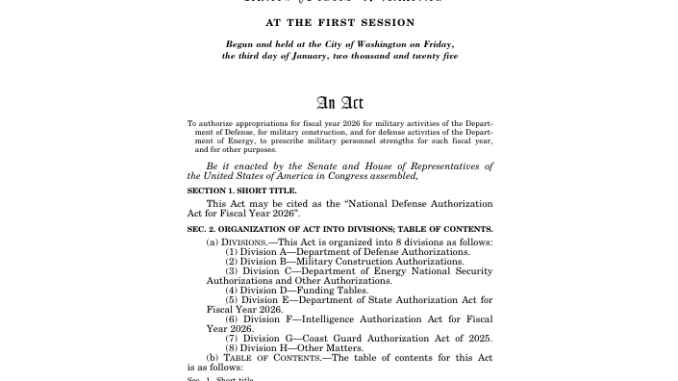
On December 18, 2025, the President of the United States signed into law the Fiscal Year 2026 National Defense Authorization Act (NDAA), formally enacting the legislation.
The Act includes historic and unprecedented provisions addressing the situation in South Mongolia (referred to by the Chinese government as the “Inner Mongolia Autonomous Region”), making it the first national law in the world to explicitly and comprehensively address South Mongolia.
Of particular significance is the swift presidential signature following the Act’s passage in the U.S. House of Representatives.
This rapid transition from congressional approval to enactment demonstrates that the human rights, environmental, cultural, and linguistic situation in South Mongolia is regarded by the United States as an urgent and important policy issue.
The South Mongolia Congress (World South Mongolia Conference) warmly welcomes this decisive and timely action by the United States.
Growing International Coordination on the South Mongolia Issue
The enactment of the NDAA reflects not only legislative efforts within the United States, but also the result of years of sustained advocacy by the Southern Mongolian Human Rights Information Center (SMHRIC) and by Southern Mongolians living across the world.
At the same time, international attention to the situation in South Mongolia has been steadily increasing—not only in the United States, but also in Japan and across Europe, particularly among democratic societies concerned with human rights and environmental justice.
Concrete Developments in Japan and the Role of the Parliamentary Group
In Japan, engagement on the South Mongolia issue has advanced significantly over the past year.
On October 9, 2025, an international forum titled
“The History and Prospects of the South Mongolia Freedom and Independence Movement”
was held in Tokyo, bringing together experts, members of parliament, and civil society representatives from Japan and abroad to discuss the historical background, current conditions, and human rights situation in South Mongolia.
On this occasion, Ms. Sanae Takaichi, President of the Liberal Democratic Party of Japan, delivered an official message to the forum in her capacity as Chair of the Parliamentary Group Supporting South Mongolia, expressing solidarity and strong concern regarding the situation in South Mongolia.
In addition, Mr. Rintaro Ishibashi, Member of the House of Representatives and Secretary-General of the Parliamentary Group, played a central role from the preparatory stage of the forum and delivered the opening address on the day of the event, demonstrating concrete parliamentary engagement in Japan.
Submission of a Petition to the Japanese Government
As a result of the discussions held at the forum, a formal petition to the Government of Japan was adopted.
The petition addressed human rights violations, threats to ethnic and cultural rights, and environmental destruction in South Mongolia, and called for Japan to recognize and address these issues from an international human rights perspective.
The petition was subsequently officially submitted to the Ministry of Foreign Affairs of Japan, marking an important step in bringing the South Mongolia issue from civil society advocacy into the realm of formal governmental dialogue.
Shared Responsibility of Democratic Allies
Japan and the United States are allies and share fundamental values of freedom, democracy, and respect for human rights.
By enacting legislation that explicitly and institutionally addresses South Mongolia, the United States has set an important precedent for democratic nations worldwide.
This development offers a clear reference point for how governments can respond, in concrete and systematic ways, to the human rights, environmental, and cultural challenges faced by Southern Mongolians.
The South Mongolia Congress will continue to work closely with partners in Japan and the international community to advance the protection and restoration of human rights, language, culture, and the natural environment in South Mongolia.
Download the Official Statement (PDF)
Official Statement (PDF)
ここにPDFのURLを貼る
Download the Official Statement (PDF)South_Mongolia_Congress_Official_Statement_NDAA_English_Final.pdf