National Diet Symposium
Report on Participation
“China’s Ethnic Regional Autonomy System and the Reality of the Uyghur Genocide”
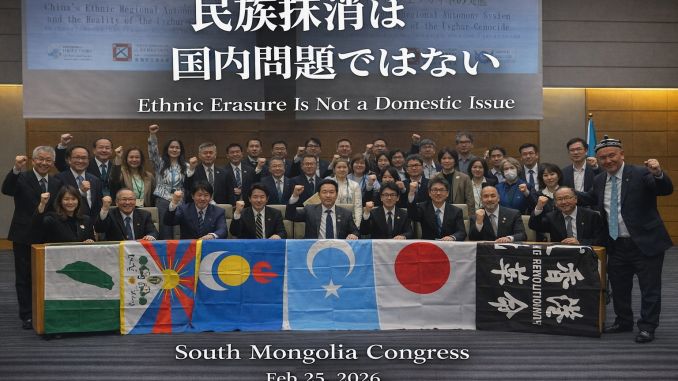
On February 25, 2026, a symposium titled
“China’s Ethnic Regional Autonomy System and the Reality of the Uyghur Genocide”
was held at the National Diet of Japan, hosted by the Japan Uyghur Association.
The symposium brought together representatives from the Japan Uyghur Association, the Taiwan Foundation for Democracy, the World Uyghur Congress, and other organizations to discuss the current human rights situation in the Xinjiang Uyghur Autonomous Region and the appropriate response of the international community.
Olhunod Daichin, Co-Chair of the South Mongolia Congress (World South Mongolia Conference), participated as a speaker in Session 3, titled “Strengthening Solidarity Among Ethnic Organizations,” and took part in the subsequent panel discussion.
In his remarks, Daichin emphasized:
- that ethnic erasure is not merely a domestic issue, but a challenge to the international order;
- that the assimilation model first institutionalized in South Mongolia has been structurally expanded in East Turkistan;
- and that the erosion of self-determination and sovereignty carries significant security implications.
He underscored that the situations in South Mongolia, East Turkistan, Tibet, and Hong Kong are not isolated cases, but structural consequences of the governing model implemented by the Chinese Communist Party. He further proposed the establishment of a cross-sectoral and institutionalized policy coordination framework within Japan.
The full text of the speech delivered at the symposium is provided below.
Ethnic Erasure and the International Order
South Mongolia Is Not a “Domestic Issue”
Olhunud Daichin
Co-Chair, South Mongolia Congress
Symposium at the National Diet of Japan
February 25, 2026
If ethnic erasure is tolerated,
borders will not survive.
This is not a rhetorical statement.
It is a structural reality of international politics.
The destruction of a people’s language, identity, and historical memory is not merely a human rights violation.
It is an assault on the foundational principles of the international order —
self-determination and sovereignty.
We are not here today simply to describe suffering.
We are here because what is happening in South Mongolia and East Turkistan is a test case for the future of international norms.
I. What Happened in South Mongolia
Since 2020, Mongolian-language education in South Mongolia has been effectively dismantled.
History textbooks have been rewritten.
Collective memory has been replaced by state narrative.
Cultural expression is allowed — but only as folklore.
Language disappears from classrooms.
Thought is standardized.
The next generation is systematically assimilated.
This is not a spontaneous social evolution.
It is state design.
It is not physical annihilation.
It is structural disassembly of a people.
II. A Replicable Model
What was first institutionalized in South Mongolia was later expanded at scale in East Turkistan.
Mass surveillance.
Re-education facilities.
Forced labor.
Birth suppression.
Family separation.
In Tibet and Hong Kong, although the mechanisms differ, the governing logic remains the same:
absolute political loyalty to the state overrides ethnic, cultural, and civic autonomy.
This is not accidental policy.
It is a governing system.
III. Why This Is Not a Domestic Matter
Let us be clear.
When a state denies a people’s right to linguistic continuity and cultural self-definition,
it is not merely exercising sovereignty.
It is redefining sovereignty.
If sovereignty becomes absolute and immune from international scrutiny,
human rights become conditional.
Self-determination becomes delegitimized.
External accountability becomes interference.
If this logic spreads,
the international order will not collapse through war —
it will erode through normative revision.
South Mongolia was an early model of this revision.
East Turkistan is its escalation.
IV. Security Implications
This issue is inseparable from regional stability.
If the principle of self-determination is weakened in one place,
the credibility of territorial integrity elsewhere becomes fragile.
One cannot simultaneously defend peace in the Taiwan Strait
while normalizing structural ethnic erasure as “internal governance.”
An order that cannot protect values
will eventually fail to protect borders.
The Free and Open Indo-Pacific framework is not merely a geopolitical concept.
It is a normative commitment.
Norms require institutional reinforcement.
V. What Must Be Done
First, parliamentary coordination must be strengthened.
Issues concerning South Mongolia, East Turkistan, Tibet, Hong Kong, and Taiwan should not be treated as isolated cases.
They are structurally connected.
Institutionalized, cross-party policy dialogue is essential.
Second, serious bipartisan discussions regarding genocide recognition must begin.
Genocide is not confined to history.
It can occur through systematic linguistic suppression, demographic engineering, and forced labor structures.
Silence is not neutrality.
Silence consolidates the status quo.
Conclusion
We are not competing in victimhood.
We are asking for solidarity in defense of norms.
If ethnic erasure is tolerated,
borders will not survive.
But if democratic nations act collectively,
the integrity of the international order can endure.
South Mongolia will not disappear.
The Uyghurs will not disappear.
Tibet will not disappear.
History ultimately favors those who defend principle over convenience.
Thank you.